
The Position of Women: A Theological and Historical Re-examination
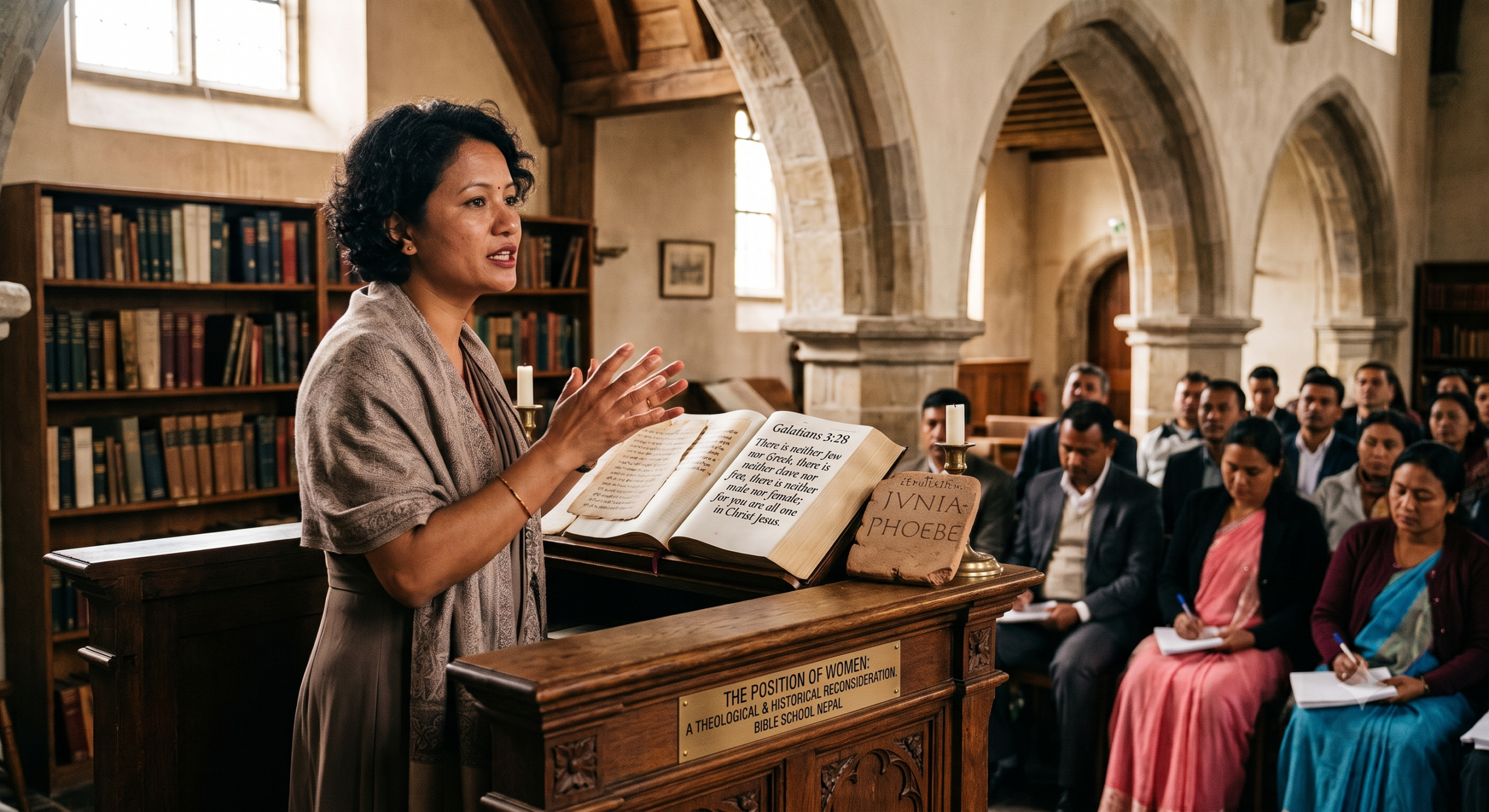
Every six months, I taught this course at the Bible college in Nepal. More than half of our students were women. In the first semester in particular, eight women and three men enrolled at our college; they had all been sent to us specifically by their own churches to be trained. So that is exactly what we did: We taught theology and culture; my wife Hope taught them English; I covered various topics; and we held a question-and-answer session every week. And we emphasised to them the equality of men and women: That they are completely equal in Christ.
However, that lesson had to be repeated every semester. In the intervening period – during the holidays between semesters – these women would return to their home congregations. There, their pastor would invariably rush to emphasise that only men can be called to be pastors. Women were not allowed to lead in the church, they were told. After which they were then sent off again by that same congregation to continue their training with us as church leaders. An impossible and utterly contradictory situation.
This phenomenon is very much alive worldwide. The Southern Baptists in the US have only recently taken a far-reaching decision. They reaffirmed that women cannot be appointed as pastors and that churches which did so could no longer be part of the denomination. Their argument? Nowhere in the Bible is there any indication that a woman is explicitly appointed as a “pastor” or shepherd. And strictly speaking, they are, in fact, entirely correct in this regard. But the full truth is that the word “pastor” (shepherd) appears only once in the entire New Testament as a church role, namely in the list of gifts in Ephesians 4:11. On all other occasions, this word (poimen) is used to refer to Jesus as the shepherd.
If we look at the specific individuals who are mentioned by name in the New Testament in connection with a particular role, we see the following figures:
- Apostles: Around 20 to 25 people are mentioned by name.
- Prophets: Around 8 to 10 people are mentioned by name.
- Evangelists: Only one person (Philip) is explicitly given this title.
- Teachers: Around 5 or 6 people are referred to as such.
- Shepherds (Pastors): No specific individual is referred to by name as a “shepherd” in the text.
So it is true that in the New Testament, no woman is appointed with the official title of “pastor”. Nor, however, is any man appointed with that specific title. So although patriarchal institutions (churches and ministries, and some political movements) like to use this point to prove that women cannot be pastors, linguistically and historically they cannot at the same time use it to justify that men are allowed to be pastors.
The same selective reading of the Bible occurs with the well-known proclamation in Galatians 3:28. This text is embraced by virtually every church to show that there is no longer any spiritual distinction between Jew (which we are not by origin) and Greek (which we are, according to the letter of the law). In this way, we demonstrate that we may draw upon and build on the covenant that God made with Abraham (which is also confirmed in the Epistle to the Hebrews). However, people immediately overlook the phrase that follows on inextricably from this: “slave or free, male or female”. As soon as that part is mentioned, the counter-argument invariably rings out: “Yes, but… the order of creation!”
So, let us take a look at that order of creation.
1. The Order of Creation and the Meaning of “Ezer”
If we wish to examine the best-known texts on the position of women in a logical, chronological order, we must start at the beginning: Genesis. In the traditional translations, we read that woman was created as man’s “helper”, formed from his “rib”.
When we delve deeper into the original Hebrew text, we discover a very different reality. A “side” or half is taken from man (the *Adam*, the unique human being who, at that time, was the only one created in the image of God). God takes half of the attributes—half of his own divine image—from man in order to use them to create a new human being as a *kenegdo*: a “counterpart”. This should not be interpreted negatively, but rather as two perfectly connecting pieces of a jigsaw puzzle. Without one, the other is incomplete. They differ in form, precisely because they are meant to fit together—both anatomically and in terms of character.
Half of the qualities that God has instilled in humanity are therefore found in women. In our Western languages, however, the word “helper” has come to carry a strongly subordinate connotation. It is used synonymously with “assistant” or “aide”: The man is the boss who does the heavy lifting, whilst the woman is allowed to lend a hand or do whatever is asked of her. The Hebrew word for helper, however, is Ezer (H5826). This word first appears in Genesis 2:18 and 20 in connection with the creation of woman. Let us look at how this word is consistently used throughout the rest of the Old Testament:
| Bible text | Text excerpt (meaning of ‘Ezer’ in the original text) |
| Exodus 18:4 | ‘…the God of my father has come to my aid (Ezer); He has delivered me from the sword of the Pharaoh.’ (God as the mighty Saviour) |
| Deuteronomy 33:7 | ‘O LORD, hear Judah’s cry for help… Stand by them (Ezer) against their enemies.’ (God as military aid) |
| Deuteronomy 33:26 | ‘Like a prince He rides across the heavens and over the clouds, to come to your aid (Ezer).’ |
| Deuteronomy 33:29 | ‘You are a people redeemed by the LORD. He is a shield and a help (Ezer) to you…’ |
| Psalm 20:1-2 | ‘…may He send help (Ezer) from His sanctuary, and from Zion may He assist you.’ |
| Psalm 33:20 | ‘We wait with longing for the LORD; He is our help (Ezer) and our shield.’ |
| Psalm 89:19 | ‘I have offered help (Ezer) to a hero, a young man raised up from among the people.’ |
| Psalm 115:9-10 | ‘…trust in the LORD – He is their help (Ezer), their shield…’ |
| Psalm 121:1-2 | ‘Where does my help come from? My help (Ezer) comes from the LORD, who made heaven and earth.’ |
| Psalm 124:8 | ‘Our help (Ezer) is in the name of the LORD, who made heaven and earth.’ (Known from the liturgical votum) |
| Psalm 146:5 | ‘Blessed are those whose help (Ezer) is the God of Jacob…’ |
| Isaiah 30:4–5 | ‘…for that people has nothing to offer. It brings neither help (Ezer) nor benefit…’ |
| Ezekiel 12:14 | ‘All those who surround him, his helpers (Ezer), and all his bands of warriors, I will… scatter…’ |
| Daniel 11:34 | ‘During their oppression, they receive some help (Ezer)…’ |
| Hosea 13:9 | ‘It is your ruin, Israel, that you turn against Me, your helper (Ezer).’ |
In which of these passages does the help, or the helper, refer to a submissive person or an inferior assistant? In none of them. The word almost always refers to God Himself as the strong, saving and protecting party. The patriarchal interpretation that a “helper” is subordinate is therefore based purely on our own Western cultural projection and lacks any basis in the original text.
2. The Fall and the Completed Work of Jesus
Both numerically and chronologically, the Fall in Genesis 3 occurs only after the perfect creation of woman. It is only in Genesis 3:16, as a direct consequence of the curse and the breach with God, that the woman is told: “You will desire your husband, and he will rule over you.”
The structural oppression and subordination of women is therefore a direct result of the Fall; it was never God’s original intention in creation. From that point on, the oppression of women spread throughout the world, and we can still see this in the culture around us to this very day. But then Jesus came. He died on the cross and took the curse upon Himself—the entire curse. This included that specific part of the curse whereby women were placed under the authority of men. Anyone who today stubbornly insists that women must remain structurally subordinate to men is, in fact, believing that Jesus did not remove the entire curse. Theologically speaking, this is a heresy that undermines the finished work of Christ on the cross.
“Yes, but what about Paul? Doesn’t he clearly write that women are to be subject to men?”
3. Paul and his Epistles: The Statistics
In the New Testament, 13 letters are traditionally attributed to the apostle Paul (from Romans through to Philemon). Within modern biblical scholarship, there is broad consensus that he definitely dictated at least 7 of these himself (the so-called proto-Pauline letters). For a pure data analysis, we examine all 13 letters bearing his name.
When we analyse these epistles for restrictions on women, we discover a striking fact: only 2 of the 13 epistles contain passages used to restrict women’s freedom of movement or authority:
- 1 Corinthians: The so-called “silence command” in chapter 14.
- 1 Timothy: The ban on teaching in chapter 2.
In the remaining 11 letters, Paul makes no mention whatsoever of a general ban on women speaking, leading or teaching. In fact, in that “silent majority” of his letters, he does exactly the opposite. In Romans 16, he concludes his theological masterpiece with a list of greetings in which a third of the active key figures mentioned are women. In Galatians 3, he writes the ultimate declaration of equality, and in Philippians 4, he explicitly refers to women as his “colleagues” who have fought side by side with him for the gospel.
If excluding women from leadership were a universal order of creation or a core value of the Kingdom of God, then logically this would have had to be set out in the major theological blueprints (such as Romans or Ephesians) and consistently reiterated to every newly established pioneer church. The fact that these restrictions appear exclusively in the letters to Corinth and Ephesus—two cities notorious in antiquity for their extreme cultural chaos, dominant cults of goddesses (Artemis and Aphrodite) and particular disorder—proves that these are local crisis measures and not a universal, timeless law.
(It is certainly interesting to delve into the history of Ephesus to get a sense of the chaos in that city, how its economy functioned, how temple prostitution operated there, and what effect that had on male-female relationships. However, this article would be more than twice as long if I were to go into that in detail, so I would encourage you to explore this for yourself. It will provide you with a good background and cultural understanding to help you interpret the letter to the Ephesians.)
4. Analysis of Popular Misinterpreted Scriptures
The “Silence Command” in Corinth (1 Corinthians 14:34–36)
This is one of the most frequently cited passages used to silence women:
“Women must remain silent in your gatherings. They must not speak, but must be in submission, as the law also states. If they wish to learn anything, they must ask their own husbands at home …”
If we apply this verse purely literally and universally, a glaring contradiction immediately arises within the same letter. In 1 Corinthians 11:5, Paul gives specific instructions on how women should pray and prophesy in the gathering. So they clearly did speak in the congregation, with Paul’s approval.
The key to this passage lies in the so-called Quotation–Refutation hypothesis. Ancient Greek at that time had no punctuation marks or quotation marks; everything was written in a continuous stream. In his letter to the Corinthians, Paul constantly quotes statements from the (probably angry) letter sent to him by the conservative men of Corinth, only to correct them mercilessly (as in 1 Corinthians 6:12 and 7:1). (It is interesting to note that what we now have as 1 and 2 Corinthians were not at all the first and second letters, but much more likely the second and fourth letters in a series of correspondence in which each letter responded to the one before it.)
In verses 34–35, Paul quotes the words of these men from Corinth, including their argument: “…as, indeed, the Law also says.” This argument reveals the external source, for nowhere in the Torah (the Law of Moses) is there a commandment forbidding women to speak. This originated from Jewish oral traditions or Roman cultural laws. In the Roman Empire at that time, there was a law which stated: “Feminae ab omnibus officiis civilibus vel publicis remotae sunt et ideo nec iudices esse possunt nec magistratum gerere nec postulare nec pro alio intervenire nec procuratores exsistere.”
Translation: “Women are excluded from all civil and public offices; therefore, they cannot be judges, become magistrates, plead in public, intervene on behalf of another, or act as legal representatives.”
The Roman historian Valerius Maximus (1st century) also wrote a handbook on Roman customs and traditions. In Book 8, Chapter 3, he devotes a rather shocking section to women who, in the past, had nevertheless dared to speak in public (in the Forum or in court).
He begins that chapter with the telling words:
“We must no longer remain silent about those women who could not be silenced in the Forum or the courts, neither by the state of their nature nor by the veil of modesty (pudor).”
He literally describes women who speak in public as monstra (monsters or unnatural phenomena), because they violated the natural order and feminine modesty by making their voices heard in the presence of men.
It therefore makes perfect sense to assume that “the law” referred to here in verses 34-35 is indeed NOT the Torah, but Roman law. Immediately afterwards, in verse 36, comes Paul’s fierce reaction. In Greek, that verse begins with the word ἢ (Eta, G2228), an exclamation of deep indignation or sarcasm (to be translated as: “What?!” or “Nonsense!”). Furthermore, the word μόνους, ‘mōnous’ (only, or alone) is in the masculine form. Paul is therefore literally saying to the men here:
“What?! Did the word of God perhaps begin with you men? Or has it reached only you men?”
Paul thus immediately dismisses the Corinthian men’s ban on speaking as patriarchal nonsense.
The ban on teaching (1 Timothy 2:11–12)
“A woman must be taught in a spirit of obedience and calm. I do not permit her to teach or to exercise authority over men; she must remain calm.”
The historical context is crucial here: Timothy was in Ephesus, the undisputed world centre of the cult of the goddess Artemis. In this cult, female priestesses were in charge of spiritual services and a strong doctrine of female superiority prevailed. Because women in that culture received hardly any theological training, some within the new Christian congregation began to introduce harmful heresies. The Greek word that Paul uses here specifically to mean “to exercise authority”—authentein—has a very aggressive connotation and literally means “to usurp”, “to dominate” or “to seize power”. Paul is therefore responding here to a local crisis: He forbids uneducated women from aggressively taking over power and teaching in the church from the incumbent leaders.
The husband as the “head” (Ephesians 5:21–24)
“Wives, submit to your own husbands, as to the Lord, for the husband is the head of the wife, just as Christ is the Head of the church; and He is the Saviour of the body.”
This section is systematically taken out of context from the opening sentence of the pericope. After all, in Ephesians 5:21, Paul first sets out the general principle for the whole church: “Submit to one another [be submissive to one another] out of reverence for Christ.” The submission that Paul advocates is therefore, in principle, reciprocal. Furthermore, in ancient times, the Greek word for “head” (kephalē) primarily meant “source” or “origin” (such as the source of a river that gives life), rather than “boss” or “commander”. The man is reminded of creation (where the man was the physical source of the woman) and is given the weighty task of loving his wife as Christ loved the Church: By sacrificing Himself completely for her.
Furthermore, the specific command to “hupotassō” (to submit) is exclusive: A woman is required to submit only to her own husband (HER husband), not to all men in general. Women are not collectively subject to the community of men. Naturally, rebellion against legitimate authority is never the intention; leaders who have been lawfully appointed over the church should be treated with respect and honour, but that is fundamentally different from a structural, existential subordination based on gender, and applies to non-leader men as much as it does to non-leader women.
5. Important Female Leaders in the New Testament
When we remove the male-centred filters of later church history, we discover an impressive network of influential female leaders in the apostolic era:
- Phoebe: Explicitly appointed by Paul in Romans 16:1–2 as a diakonos (deacon) and prostatis (patroness/financial supporter). She was entrusted with Paul’s most important theological masterpiece—the Epistle to the Romans—to take it to Rome. In ancient times, the role of letter-bearer involved reading the letter aloud to the local house churches, explaining it and answering questions about it. A woman was thus the very first exegete and teacher of Paul’s central gospel in the capital of the Roman Empire.
- Junia: Recognised by Paul in Romans 16:7 as an apostle of great standing within their circle. Early Church Fathers such as John Chrysostom openly praised her in the 4th century as an extraordinary female apostle. It was not until the Middle Ages that male translators systematically changed her name to the male form ‘Junias’, because they dogmatically refused to believe that a woman could be an apostle.
- Priscilla (Prisca): Church leader and theologian. In four of the six references to her in the New Testament, she is deliberately mentioned before her husband Aquila, which was entirely unusual at the time and emphasises her leading role. It was she who, together with her husband, corrected and refined the theology of the powerful and eloquent speaker Apollos (Acts 18:26).
- Lydia: The very first Christian convert on European soil (Acts 16). As a wealthy, independent purple-dye merchant, she opened her home, which immediately became the very first house church and the strategic missionary base for the church in Philippi.
- Mary (mother of John Mark): One of the leaders of the strategic mother church in Jerusalem. When Peter miraculously escaped from prison (Acts 12:12), he went straight to her house, as this was the main operational centre where the congregation gathered.
- Chloe (1 Corinthians 1:11): Head of an influential household and network in Corinth. She possessed the undeniable authority to send her people to Paul to raise and address issues within the church.
- Nympha (Colossians 4:15): Specifically greeted by Paul as the leader and facilitator of the Christian congregation that met in her own home.
- Euodia and Syntyche (Philippians 4:2–3): Described by Paul as his full “colleagues” who fought side by side with him for the gospel. Their conflict with one another was so significant that it had the potential to split the entire church in Philippi, which demonstrates their enormous social and spiritual impact. (Of course, in itself it is a negative thing when a church nearly splits. However, if these women had not been held in high regard, their conflict could never have come close to causing a schism, for then no one would have followed them. Thus, it is precisely this near-schism that shows these women were respected leaders)
6. The Prophetic Daughters of Philip and the Early Church
Finally, Acts 21:9 mentions that the evangelist Philip had four unmarried daughters who possessed the gift of prophecy. In the post-biblical writings of early church history, these women were not regarded as a mere historical footnote, but as pillars within the apostolic succession:
- Papias of Hierapolis (c. 60–130 AD): As an early Apostolic Father, he lived in the same region (Hierapolis) to which Philip and his daughters moved in later life. In the surviving Fragments of Papias, he writes that he met the daughters in person and heard eyewitness accounts from their own lips about the very earliest days of the church, including the raising of a dead person.
- Eusebius of Caesarea (c. 260 – 339 AD): In his authoritative standard work, *Church History* (*Historia Ecclesiastica*)—particularly in Book 3 (chapters 31 and 39) and Book 5 (chapter 17)—he refers to the daughters as “powerful lights” of the early church. Eusebius explicitly uses them as the historical benchmark for how true, orderly prophecy in the Holy Spirit ought to function, in stark contrast to the chaotic, ecstatic excesses of later heresies such as Montanism.
- Polycrates of Ephesus (c. 130 – 196 AD): In his synodal letter to the Bishop of Rome around the year 190 AD, he mentions the daughters of Philip in the same breath as the greatest spiritual leaders of Asia and confirms that they “lived in the Holy Spirit”.
When we take an honest look at the entire history of the Bible and early Christianity, we cannot help but conclude that, from the very first day, women have led, taught, facilitated and prophesied. Structural subordination was abolished on the cross; in the Kingdom of God, man and woman are inseparably one.